

The string stamped inside almost every frame, something like 52□18-140, is the boxing system: a standardized way to measure a spectacle frame in millimeters. The first number is the eye size (horizontal lens width), the small square is the boxing-system symbol, the second number is the bridge width (the gap between the lenses), and the third is the temple length. Those three numbers, plus two more that are not stamped, control whether a frame fits the face, where the optical center lands in front of the pupil, and whether a given lens blank is even large enough to cut, which you can check with the minimum blank size calculator.
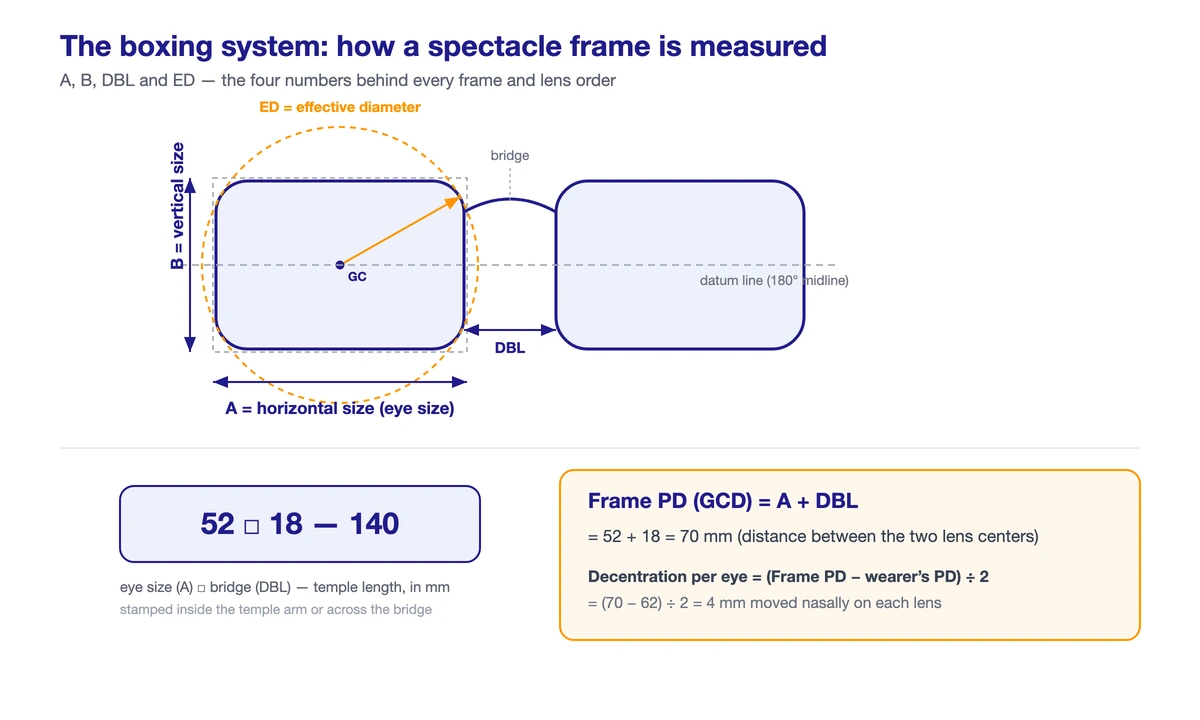
The boxing system was adopted in the United States in 1962 by the Optical Manufacturers Association to replace the older datum system, and the measurements are now defined internationally in ISO 8624 (spectacle frame measuring system and vocabulary), with the marking requirements set out in ISO 12870. The name comes from the method: every lens shape is treated as if it sits inside the smallest possible rectangle, or box, and measured against the sides of that box.
What the Numbers Stamped on Your Glasses Mean
Read the marking left to right. Using 52□18-140 as the example:
| Marking | Name | What it is |
|---|---|---|
| 52 | Eye size (A) | Horizontal width of one lens opening, in mm |
| □ | Box symbol | Confirms the numbers use the boxing system |
| 18 | DBL (bridge) | Distance between the two lenses at their closest point, in mm |
| 140 | Temple length | Overall length of the side arm, in mm |
The numbers are usually engraved on the inside of one temple arm, and on rimless or some metal frames they appear on the bridge. Eye size and bridge typically run from the high 30s to the high 50s for eye size and 14 to 24 for the bridge; temple length is most often 135, 140, or 145.
A frame marked 52□18 is not interchangeable with one marked 54□16 even though both add up to 70, because the eye size and bridge place the lenses differently relative to the wearer’s eyes. That distinction is the whole point of the system.
The Boxing System: A, B, DBL and ED
The boxing system describes a lens shape with four measurements taken against its bounding box. As the Laramy-K dispensing reference puts it, each value is “the distance between the vertical sides of the box” or its horizontal equivalent.
| Symbol | Measurement | Definition |
|---|---|---|
| A | Horizontal lens size (eye size) | Width between the vertical tangents of the lens shape |
| B | Vertical lens size | Height between the horizontal tangents of the lens shape |
| DBL | Distance between lenses | Shortest distance between the nasal edges of the two lenses |
| ED | Effective diameter | Twice the longest radius from the lens’s geometric center to its farthest edge |
Two reference points complete the picture. The geometric center (also called the boxing center) is the middle of the box, where the horizontal midline meets the vertical midline. The datum line is that horizontal midline, the 180-degree line running through both lenses.
The effective diameter (ED) deserves attention because it is the one value that decides whether a lens will fit. It is the diameter of the smallest circle, centered on the geometric center, that completely encloses the lens shape. A round lens has an ED equal to its eye size; any other shape has an ED larger than both A and B, because the corners reach farther from the center than the flat sides do. ED is the same concept behind the difference between frame eye size and effective diameter that drives how thick a finished lens turns out.
Frame PD: The Number That Is Not Stamped
Add the eye size and the bridge and you get the frame PD, also called the geometric center distance (GCD) or distance between centers:
Frame PD = A + DBL
For 52□18, the frame PD is 52 + 18 = 70 mm. This is the horizontal distance between the geometric centers of the two lenses, confirmed by the ISO 8624 dispensing literature which derives it as eye size plus bridge. It is exact, not an estimate, because each geometric center sits half an eye size from the nasal edge: half of A, plus the bridge, plus another half of A, equals A plus DBL.
Frame PD matters because it is rarely the same as the wearer’s pupillary distance. The average adult binocular PD is around 62 to 64 mm, while a frame might be built for 70. The gap between the two is what the lab has to correct.
Decentration: Matching the Frame to the Wearer
When frame PD is wider than the wearer’s PD, the optical center of each lens has to be moved inward (nasally) so it lands in front of the pupil rather than in the middle of the lens box. That horizontal shift is decentration:
Decentration per lens = (Frame PD − wearer’s PD) ÷ 2
For a 70 mm frame PD and a 62 mm wearer PD, total decentration is 8 mm, or 4 mm inward on each lens, matching the worked figures in the OpticianWorks layout reference. Get this wrong and the optical center sits off the pupil, which induces unwanted prism through Prentice’s rule and pushes the pair outside the manufacturing tolerances that a finished lens has to meet. A wider frame demands more decentration, and more decentration demands a larger lens blank.
Minimum Blank Size: Will the Lens Physically Fit?
Decentration has a hard physical limit: the lens blank has to be big enough to still cover the whole frame shape after the optical center is shifted off-center. The check is the minimum blank size (MBS):
MBS = ED + (2 × decentration) + 2 mm
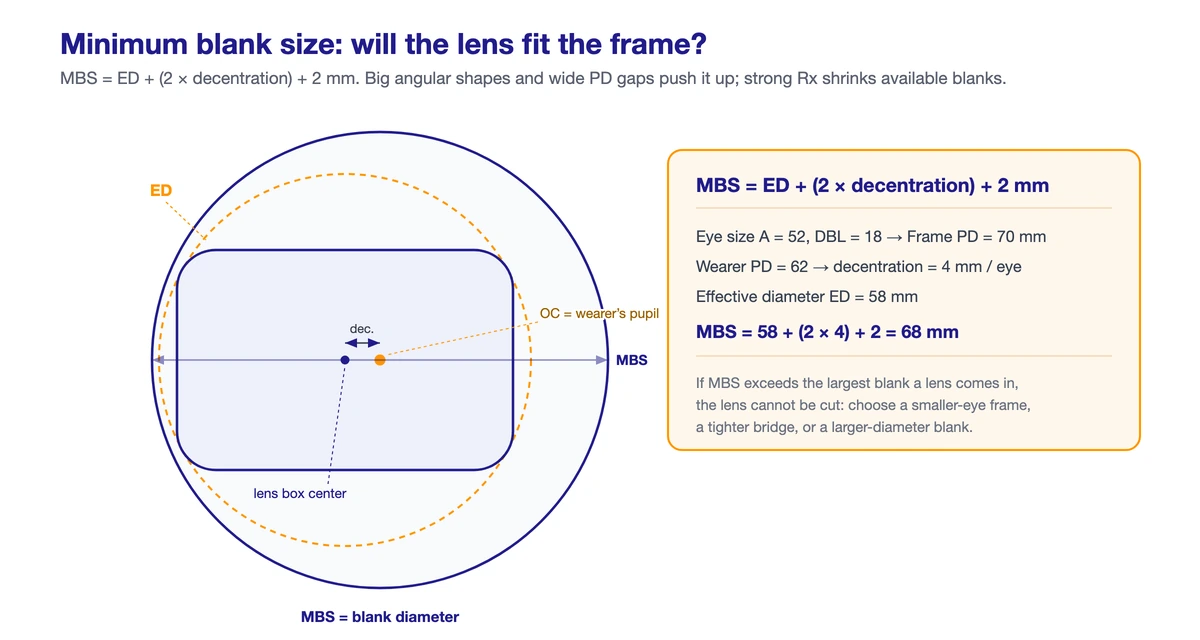
The 2 mm is an edging allowance for chips and small misalignments during glazing, the value taught in the ISO 8624 minimum-blank guidance and the OpticianWorks cut-size lesson. Worked through with an ED of 58 mm and 4 mm of decentration per lens: MBS = 58 + (2 × 4) + 2 = 68 mm. If the lens you want comes in a 65 mm blank, it cannot be cut for this job, and the fix is a smaller-eye frame, a tighter bridge that reduces decentration, or a lens available in a larger diameter.
| What changes | Effect on minimum blank size |
|---|---|
| Larger eye size or shape with corners (higher ED) | Increases |
| Wider frame PD vs. wearer PD (more decentration) | Increases |
| Narrower bridge for the same eye size | Decreases decentration, lowers MBS |
| Smaller, rounder lens shape | Decreases |
This is why a strong prescription in a wide, square frame for a patient with a narrow PD is the classic combination that will not cut: high ED, high decentration, and often a thick lens all at once.
Why the Boxing System Still Matters at the Dispensing Desk
The frame numbers are not trivia. They drive three decisions on every order: whether the frame suits the wearer’s PD without excessive decentration, whether the chosen lens will physically fit, and where the optical center has to be placed for the prescription to be accurate. Each of those depends on pairing the frame measurements with an accurate PD and fitting height. A frame PD read off the marking is reliable; the wearer’s PD is only as reliable as the measurement. Tools such as Optogrid that capture PD and centration from a photo of the patient in the chosen frame give the lab the wearer-side numbers that the boxing system then converts into a correct layout.
For frame selection itself, the boxing measurements work alongside material and frame adjustment considerations covered in the guide to choosing eyeglass frames.
Frequently Asked Questions
What do the numbers on my glasses mean?
They are the boxing-system measurements in millimeters. In a marking like 52□18-140, the first number is the eye size (the horizontal width of one lens), the second is the bridge or distance between the lenses, and the third is the temple length. The small square between the first two numbers shows the measurements follow the boxing system.
What does the small square symbol on my glasses mean?
The square (□) is the boxing-system symbol. It tells you that the eye size and bridge numbers were taken using the boxing method, where each lens is measured against the rectangle that just encloses it. It is required as part of the frame marking under ISO 12870.
What is the difference between eye size and effective diameter?
Eye size (the A measurement) is the horizontal width of the lens. Effective diameter (ED) is twice the longest distance from the lens’s geometric center to its edge, so it captures the diagonal reach of the shape. ED is always equal to or larger than the eye size, and it is the value that determines whether a lens blank is large enough to cut.
How do I find my frame PD?
Add the eye size and the bridge: frame PD = A + DBL. A frame marked 52□18 has a frame PD of 70 mm. This is the distance between the optical centers of the two lens openings, and it is compared against the wearer’s pupillary distance to work out how far each optical center must be decentered.
Why does my frame PD differ from my pupillary distance?
Frame PD is a property of the frame, while pupillary distance is a property of your eyes. They rarely match. When the frame PD is larger than your PD, the lab moves each optical center inward by half the difference so the optical centers sit in front of your pupils. This shift is called decentration.
Can any lens fit any frame?
No. A lens can only be cut to a frame if its blank is large enough to cover the shape after decentration. The minimum blank size is ED + (2 × decentration) + 2 mm. A large, angular frame paired with a narrow PD needs a bigger blank, and some lens materials or designs are not made large enough to satisfy that requirement.

I grew up inside an optical shop. My mother likes to tell how, as a kid, I would watch eyeglasses being assembled, play with the tools, and draw on the back of service order slips. The family business taught me early what a precise measurement and work done right are worth.
I went on to spend more than twenty years as a software engineer, always keeping an eye on the optical world. Optogrid was born where the two meet: digital measurement technology (pupillary distance and fitting heights) built by someone who knows the dispensing counter from the inside.